
Species of mushroom “new to science” discovered at Burnham Beeches
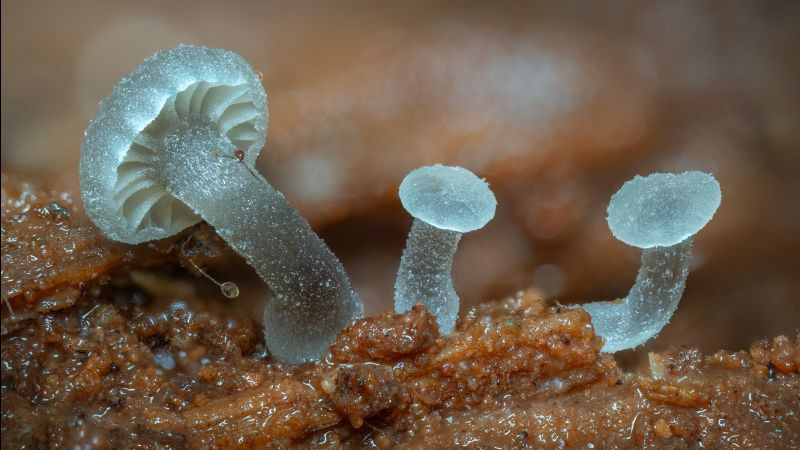
News comes as City of London Corporation open spaces chiefs urge public not to pick rare and delicate fungi
A species of mushroom, new to science, has been discovered at one of the City of London Corporation’s open spaces in Buckinghamshire.
Burnham Beeches has been a Site of Special Scientific Interest since 1951, was declared a National Nature Reserve in 1993, and designated as a Special Area of Conservation in 2005.
The mysterious, tiny mycenoid was found on a damp piece of rotting pine at the site by photographer and member of the Bucks Fungus Group, Barry Webb, in August 2021.
After years of research, only now has it formally been given a name – Hydropus inopinatus – shedding light on the rich biodiversity of fungi in ancient woodlands. [For details on the official publication, please see notes to editors].
Standing at less than 15mm in height, this tiny white saprophytic species feeds off the dead wood on which it grows, accelerating the natural decomposition process and returning nutrients back to the soil which benefits other organisms and enhances the biodiversity of this ancient landscape.
The news comes as the City Corporation’s open spaces leaders urge visitors not to pick or forage mushrooms due to their importance for biodiversity, and the health and preservation of ancient trees.
The organisation manages a network of 11,000 acres of internationally important open space across London and southeast England – including Epping Forest and Hampstead Heath – investing over £38m a year.
Ben Murphy, Chairman of the City Corporation’s Epping Forest and Commons Committee, which includes Burnham Beeches, said:
“This important discovery not only adds to our understanding of fungi in the UK, but also underscores the critical role we have as conservators to maintain and protect some of the country’s greatest natural assets.
“Burnham Beeches was bought by the City Corporation in 1880 with the mission of protecting it as a public open space and wildlife reserve.
“Fungi play an incredibly important role in the delicate balance of biodiversity which makes our open spaces so special. We welcome the millions of people who come to enjoy our protected sites, but I urge visitors to leave the fungi how they find them – untouched.”
Chair of the City Corporation’s Natural Environment Board, Caroline Haines, said:
“Picking mushrooms may seem harmless, but it actually damages our wildlife habitats and threatens rare species.
“We want people to come and enjoy our open spaces and experience these natural wonders for themselves.
“By all means take photos, but our message is clear: click, don’t pick.”
Chair of the City Corporation’s Hampstead Heath, Highgate Wood and Queen’s Park Committee, William Upton KC, added:
“We are fortunate to be guardians of some of the most important sites for nature conservation and scientific interest in the world.
“Hampstead Heath is home to over 400 veteran trees which often rely on fungi to thrive and survive. More than 650 types of fungi have been discovered here – and while that might seem like a big number, it’s all part of a delicately balanced ecosystem.
“So, please, take pictures, but don’t forage or pick for mushrooms in our open spaces.”
Penny Cullington from the Bucks Fungus Group said:
“After years of research and double-checking, we felt we were finally in a position to publish a paper about our exciting discovery.
“Whilst this little mushroom is basically quite similar to other small white species, there are significant differences - both microscopic and molecular - which make it unique.
“Inopinatus literally means ‘a surprise’, which seemed to us an apt name for this tiny and apparently rare mushroom, first discovered by Barry, and which seems to be thriving at Burnham Beeches.”
A recent report revealed that the network of internationally important open spaces managed by the City of London Corporation are worth £282.6 million each year in benefits to society, and £8.1 billion over 50 years.
ENDS
Notes to editors
The City of London Corporation is the governing body of the Square Mile, dedicated to a vibrant and thriving City, supporting a diverse and sustainable London within a globally-successful UK – www.cityoflondon.gov.uk.
Burnham Beeches is a 540 acre woodland, heath, wood pasture, common, and wetland, and one of several sites managed by the City Corporation as a registered charity – www.cityoflondon.gov.uk/things-to-do/green-spaces/burnham-beeches-and-stoke-common/visit-burnham-beeches.
It has taken the intervening years since the fungus was first discovered to research whether it had been previously described before official publication could take place.
Describing a new species to science involves a formal process in which researchers document and publish its unique characteristics. This includes examining the species' morphology and genetics, comparing it with known species, and assigning it a scientific name. Once published in a peer-reviewed journal, the new species is recognised and contributes to our understanding of biodiversity and conservation.
‘Hydropus inopinatus – a new species described from the UK’ was published in August 2024 (Field Mycology vol 25 (3)) and written by Penny Cullington who co-authored the species together with Barry Webb, Eric Janke and Mike Harrison – all of whom were involved in its discovery and subsequent research.
For more information on the Bucks Fungus Group visit www.bucksfungusgroup.org.uk.